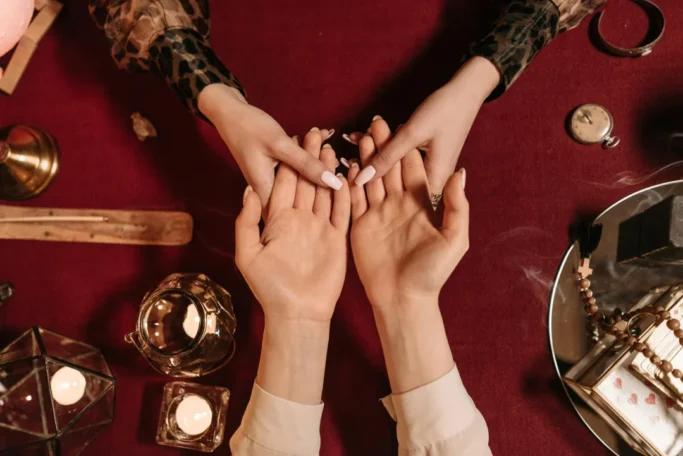
In the vast panorama of esoteric love, there is one concept that, more than others, fascinates, intrigues, and challenges what we think we know about relationships: the spiritual bond. It is not a gesture, an object, or a formula, but a symbolic representation that spans ancient cultures, shamanic traditions, spiritual philosophies, and popular beliefs. The spiritual bond is the idea that two souls can recognize each other, connect, and intertwine in a form of harmony that transcends materiality and touches deeper dimensions of human experience.
When we talk about a “spiritual bonding ritual,” we shouldn’t imagine a defined act or procedure. Rather, it’s a set of narratives, images, symbols, and interpretations that attempt to give form to an abstract concept: the connection between two essences. Many esoteric enthusiasts consider this ritual one of the most delicate, precisely because it involves elements related to emotional identity, inner experience, and the profound vibrations of affectivity.
The first thing to clarify is that the spiritual bond is not a constraint, it is not a means of holding someone back, it is not a forced bond. Authentic esoteric traditions have always insisted on a fundamental concept: a true bond is not created through coercion, but through harmony. When two people vibrate on the same emotional frequency, a spontaneous connection is created. The spiritual bond ritual, symbolically, serves to explore, understand, or acknowledge this connection, not to manipulate it.
To understand the origins of this symbolism, we need to look at the cultures that have placed value on subtle energies. In the shamanic traditions of South America, for example, there is often talk of the “invisible thread” that unites two kindred spirits. This thread is not a bond, but a bridge. Ancient tales describe how shamans recognized the presence of this thread when two people seemed to understand each other without words, perceive each other from a distance, share similar dreams or intuitions. These tales, more poetic than literal, highlight a fundamental aspect of the spiritual bond: the depth of emotional intuition.
In the Eastern world, particularly in Indian philosophy, the concept takes on different forms. It speaks of energy, vibrations, and karmic connections. Some ancient texts suggest that two souls can meet multiple times throughout their lives, repeating cycles of shared growth. These ideas should not be interpreted as absolute truths, but as images that help us reflect on why certain relationships leave a deeper mark on us than others. The feeling of “having already known” a person, for example, is a recurring psychological phenomenon, which esotericism translates into symbolic terms.
In ancient Greece, there are tales that speak of the “soul mate,” not as a missing half, but as a kindred spirit. Plato, in the Symposium, describes the search for affinity as a journey toward completeness. Here too, a fundamental point emerges: the relationship is seen not as a possession, but as an encounter. The spiritual bond is a shared path, not a chain.
In the African context, especially in the traditions of Central Africa, the concept of a bond between two essences is linked to the ancestral spirit. The strongest relationships were considered blessed by ancestors. The spiritual bond, in this context, is an alignment: two people who, in their union, create harmony that is reflected throughout the entire community. This isn’t about romanticism in the modern sense, but about a mutual energy that strengthens and sustains.
These traditions, though different, converge on one fundamental point: the spiritual bond is a harmony, not a domination. It is an encounter, not an imposition. This is essential to understand, especially in the modern world, where esotericism is often misunderstood and simplified. The symbol of the spiritual bond can be extremely powerful, but it is easily misunderstood when approached without guidance. For this reason, on any journey that touches on such sensitive issues, the presence of an experienced esoteric practitioner is essential.
An esoteric practitioner doesn’t “create” a bond, force it, or manipulate it. Rather, they help you read symbols, interpret energetic dynamics, and above all, understand whether the perceived bond is authentic, mutual, and healthy. Many people, driven by emotion or loss, can mistake for a spiritual bond what is actually attachment, fear, or idealization. An experienced practitioner is able to distinguish these phenomena, guiding the person toward a more balanced understanding.
The spiritual bonding ritual, when interpreted correctly, isn’t about attracting someone specific, but about understanding the profound nature of the relationship you’re experiencing. The questions that emerge from this symbolic journey are often introspective: why does this person hold such a special appeal for me? What emotions does it stir? What parts of me does it awaken? What does it make me see of myself?
A true journey through spiritual connection leads to a broader vision of love. It’s no longer a quest for possession, but a shared journey. No longer a need, but a recognition. No longer a tension, but a growth. It’s an evolution that requires awareness and emotional maturity. And it often requires the help of an expert capable of distinguishing between emotion and symbolism.
Symbolically, the spiritual bond is represented in many ways. The thread, the braid, the spiral, the light, the double flame, the shared breath. Each culture has used a different image, but they all point to the same idea: a connection that transcends the surface of the material relationship. However, none of these symbols imply coercion. The encounter between two kindred spirits cannot be forced, precisely because it arises from a natural reciprocity.
Many people who approach this type of symbolism seek answers to deeply human questions: Why do I feel so strongly about this person? Why can’t I forget them? Why does the connection seem so strong? The role of the esoteric practitioner is essential here: to help the person distinguish between a spiritual bond and an unresolved emotional bond. The two may seem similar, but they are not. A spiritual bond brings expansion, while a blocked emotional bond brings suffering. An expert helps understand the difference.
In the symbolic journey of spiritual connection, another fundamental theme emerges: emotional responsibility. When you perceive a strong bond with someone, it’s easy to idealize, project expectations, and interpret every gesture as a sign. But a true esoteric journey teaches us to stay centered. It’s not about interpreting every emotion as destiny, but about understanding what those emotions reveal about us. A genuine spiritual connection is an opportunity for inner growth. It isn’t created to fill a void, but to reveal a possibility.
Here too, the guidance of a practitioner is essential. Without a competent professional, the risk is seeing symbols where there are none, fueling illusions, and misinterpreting temporary emotions as eternal connections. The esoteric practitioner not only interprets symbols, but also offers balance, measure, and reference points. They teach how to read internal signals with clarity, not with anxiety or emotional outbursts.
Spiritual connection, when approached with maturity, becomes a journey of discovery. Many discover they develop deep connections with multiple people throughout their lives, not in romantic terms, but in evolutionary ones. Every important connection leaves a mark, brings a lesson, opens a door. And often, it’s only with the guidance of an expert that these lessons are truly understood.
Ultimately, the spiritual bonding ritual isn’t about uniting two people, but about revealing what already unites them. It’s a symbolic journey that invites us to observe the relationship from a broader, deeper, and more conscious perspective. The experienced esoteric practitioner is the person who allows us to navigate this complex territory without getting lost in symbols, emotions, or distorted interpretations.
The spiritual bond is a mirror: it reflects who we are and what we can become. It’s an invitation to recognize not only the other, but also ourselves. And when you undertake this path with the right guidance, what you discover is not a mysterious external force, but your own ability to experience love more broadly, kindly, and consciously.